 Add to Chrome
 Add to Firefox
 Add to Edge
DGSG-Mind: Dynamic 3D Gaussian Scene Graphs for Long-Term Scene Understanding and Grounding
May 28, 2026
Integrating open-vocabulary semantic information into dynamic 3D scene representations is essential for long-term embodied scene understanding. However, existing methods often suffer from fragile instance association due to incomplete cross-view cues, while their limited ability to handle object-level topological changes restricts long-term robotic task execution. Moreover, current 3D scene understanding methods either rely on simple feature matching without explicit spatial reasoning or assume offline ground-truth 3D geometry. To address these challenges, we present DGSG-Mind, a hybrid instance-aware 3D Gaussian dynamic scene graph system with an embodied reasoning agent. Our system couples a probabilistic voxel grid with explicit 3D Gaussians to enable robust cross-modal instance fusion and incremental semantic mapping. It handles dynamic changes through Gaussian-based visual relocalization and localized masked refinement guided by geometric-semantic consistency. Built on the instance Gaussian map, DGSG-Mind further constructs a hierarchical scene graph and develops the 3D Gaussian Mind, which integrates structural relations, spatial-semantic information, and visually annotated RoI Gaussian renderings for multimodal reasoning. Extensive experiments show that DGSG-Mind achieves the best zero-shot 3DVG performance among methods operating on self-reconstructed maps, while also delivering strong performance in 3D open-vocabulary semantic segmentation and scene reconstruction. We further deploy DGSG-Mind on real-world robots to demonstrate its target-oriented reasoning and dynamic update capabilities. The project page of DGSG-Mind is available at https://icr-lab.github.io/DGSG-Mind

Adaptive 3D Convolution for Remote Sensing Image Fusion
May 10, 2026Remote sensing image fusion aims to create a high-resolution multi/hyper-spectral image from a high-resolution image with limited spectral information and a low-resolution image with abundant spectral data. Recently, deep learning (DL) techniques have shown significant effectiveness in this area. Most DL-based methods approach image fusion as a 2D problem by encoding spectral information into feature map channels. However, our research suggests that this strategy introduces notable spectral distortions. In contrast, some methods consider spectral data as an additional dimension, utilizing standard 3D convolutions to preserve spectral information. Nevertheless, in a standard 3D convolutional layer, the same set of kernels is applied across all input regions, which we have found to be sub-optimal for image fusion. Furthermore, standard 3D convolutions necessitate substantial computational resources. To address these challenges, we propose a novel convolutional paradigm called Adaptive 3D Convolution (Ada3D) for remote sensing image fusion. Ada3D applies a unique set of 3D kernels to each input voxel, enabling the capture of fine-grained details. These adaptive kernels are generated through a two-step process: (i) spatial and spectral kernels are derived from their respective image sources; (ii) these two types of kernels are then combined to form content-aware 3D kernels that effectively integrate spatial and spectral information. Additionally, adaptive biases are introduced to enhance the convolutional outcome at the voxel level. Furthermore, we incorporate the group convolution technique to reduce computational complexity. As a result, Ada3D offers full adaptivity in an efficient manner. Evaluation results across five datasets demonstrate that our method achieves SOTA performance, underscoring the superiority of Ada3D. The code is available at https://github.com/PSRben/Ada3D.
TurboTalk: Progressive Distillation for One-Step Audio-Driven Talking Avatar Generation
Apr 16, 2026Existing audio-driven video digital human generation models rely on multi-step denoising, resulting in substantial computational overhead that severely limits their deployment in real-world settings. While one-step distillation approaches can significantly accelerate inference, they often suffer from training instability. To address this challenge, we propose TurboTalk, a two-stage progressive distillation framework that effectively compresses a multi-step audio-driven video diffusion model into a single-step generator. We first adopt Distribution Matching Distillation to obtain a strong and stable 4-step student, and then progressively reduce the denoising steps from 4 to 1 through adversarial distillation. To ensure stable training under extreme step reduction, we introduce a progressive timestep sampling strategy and a self-compare adversarial objective that provides an intermediate adversarial reference that stabilizes progressive distillation. Our method achieve single-step generation of video talking avatar, boosting inference speed by 120 times while maintaining high generation quality.
Direct Discrepancy Replay: Distribution-Discrepancy Condensation and Manifold-Consistent Replay for Continual Face Forgery Detection
Apr 14, 2026Continual face forgery detection (CFFD) requires detectors to learn emerging forgery paradigms without forgetting previously seen manipulations. Existing CFFD methods commonly rely on replaying a small amount of past data to mitigate forgetting. Such replay is typically implemented either by storing a few historical samples or by synthesizing pseudo-forgeries from detector-dependent perturbations. Under strict memory budgets, the former cannot adequately cover diverse forgery cues and may expose facial identities, while the latter remains strongly tied to past decision boundaries. We argue that the core role of replay in CFFD is to reinstate the distributions of previous forgery tasks during subsequent training. To this end, we directly condense the discrepancy between real and fake distributions and leverage real faces from the current stage to perform distribution-level replay. Specifically, we introduce Distribution-Discrepancy Condensation (DDC), which models the real-to-fake discrepancy via a surrogate factorization in characteristic-function space and condenses it into a tiny bank of distribution discrepancy maps. We further propose Manifold-Consistent Replay (MCR), which synthesizes replay samples through variance-preserving composition of these maps with current-stage real faces, yielding samples that reflect previous-task forgery cues while remaining compatible with current real-face statistics. Operating under an extremely small memory budget and without directly storing raw historical face images, our framework consistently outperforms prior CFFD baselines and significantly mitigates catastrophic forgetting. Replay-level privacy analysis further suggests reduced identity leakage risk relative to selection-based replay.
From Intuition to Investigation: A Tool-Augmented Reasoning MLLM Framework for Generalizable Face Anti-Spoofing
Mar 01, 2026Face recognition remains vulnerable to presentation attacks, calling for robust Face Anti-Spoofing (FAS) solutions. Recent MLLM-based FAS methods reformulate the binary classification task as the generation of brief textual descriptions to improve cross-domain generalization. However, their generalizability is still limited, as such descriptions mainly capture intuitive semantic cues (e.g., mask contours) while struggling to perceive fine-grained visual patterns. To address this limitation, we incorporate external visual tools into MLLMs to encourage deeper investigation of subtle spoof clues. Specifically, we propose the Tool-Augmented Reasoning FAS (TAR-FAS) framework, which reformulates the FAS task as a Chain-of-Thought with Visual Tools (CoT-VT) paradigm, allowing MLLMs to begin with intuitive observations and adaptively invoke external visual tools for fine-grained investigation. To this end, we design a tool-augmented data annotation pipeline and construct the ToolFAS-16K dataset, which contains multi-turn tool-use reasoning trajectories. Furthermore, we introduce a tool-aware FAS training pipeline, where Diverse-Tool Group Relative Policy Optimization (DT-GRPO) enables the model to autonomously learn efficient tool use. Extensive experiments under a challenging one-to-eleven cross-domain protocol demonstrate that TAR-FAS achieves SOTA performance while providing fine-grained visual investigation for trustworthy spoof detection.
UPA: Unsupervised Prompt Agent via Tree-Based Search and Selection
Jan 30, 2026Prompt agents have recently emerged as a promising paradigm for automated prompt optimization, framing refinement as a sequential decision-making problem over a structured prompt space. While this formulation enables the use of advanced planning algorithms, these methods typically assume access to supervised reward signals, which are often unavailable in practical scenarios. In this work, we propose UPA, an Unsupervised Prompt Agent that realizes structured search and selection without relying on supervised feedback. Specifically, during search, UPA iteratively constructs an evolving tree structure to navigate the prompt space, guided by fine-grained and order-invariant pairwise comparisons from Large Language Models (LLMs). Crucially, as these local comparisons do not inherently yield a consistent global scale, we decouple systematic prompt exploration from final selection, introducing a two-stage framework grounded in the Bradley-Terry-Luce (BTL) model. This framework first performs path-wise Bayesian aggregation of local comparisons to filter candidates under uncertainty, followed by global tournament-style comparisons to infer latent prompt quality and identify the optimal prompt. Experiments across multiple tasks demonstrate that UPA consistently outperforms existing prompt optimization methods, showing that agent-style optimization remains highly effective even in fully unsupervised settings.
One Ring to Rule Them All: Unifying Group-Based RL via Dynamic Power-Mean Geometry
Jan 30, 2026Group-based reinforcement learning has evolved from the arithmetic mean of GRPO to the geometric mean of GMPO. While GMPO improves stability by constraining a conservative objective, it shares a fundamental limitation with GRPO: reliance on a fixed aggregation geometry that ignores the evolving and heterogeneous nature of each trajectory. In this work, we unify these approaches under Power-Mean Policy Optimization (PMPO), a generalized framework that parameterizes the aggregation geometry via the power-mean geometry exponent p. Within this framework, GRPO and GMPO are recovered as special cases. Theoretically, we demonstrate that adjusting p modulates the concentration of gradient updates, effectively reweighting tokens based on their advantage contribution. To determine p adaptively, we introduce a Clip-aware Effective Sample Size (ESS) mechanism. Specifically, we propose a deterministic rule that maps a trajectory clipping fraction to a target ESS. Then, we solve for the specific p to align the trajectory induced ESS with this target one. This allows PMPO to dynamically transition between the aggressive arithmetic mean for reliable trajectories and the conservative geometric mean for unstable ones. Experiments on multiple mathematical reasoning benchmarks demonstrate that PMPO outperforms strong baselines.
Pose-RFT: Enhancing MLLMs for 3D Pose Generation via Hybrid Action Reinforcement Fine-Tuning
Aug 11, 2025Generating 3D human poses from multimodal inputs such as images or text requires models to capture both rich spatial and semantic correspondences. While pose-specific multimodal large language models (MLLMs) have shown promise in this task, they are typically trained with supervised objectives such as SMPL parameter regression or token-level prediction, which struggle to model the inherent ambiguity and achieve task-specific alignment required for accurate 3D pose generation. To address these limitations, we propose Pose-RFT, a reinforcement fine-tuning framework tailored for 3D human pose generation in MLLMs. We formulate the task as a hybrid action reinforcement learning problem that jointly optimizes discrete language prediction and continuous pose generation. To this end, we introduce HyGRPO, a hybrid reinforcement learning algorithm that performs group-wise reward normalization over sampled responses to guide joint optimization of discrete and continuous actions. Pose-RFT further incorporates task-specific reward functions to guide optimization towards spatial alignment in image-to-pose generation and semantic consistency in text-to-pose generation. Extensive experiments on multiple pose generation benchmarks demonstrate that Pose-RFT significantly improves performance over existing pose-specific MLLMs, validating the effectiveness of hybrid action reinforcement fine-tuning for 3D pose generation.
SyncTalk++: High-Fidelity and Efficient Synchronized Talking Heads Synthesis Using Gaussian Splatting
Jun 17, 2025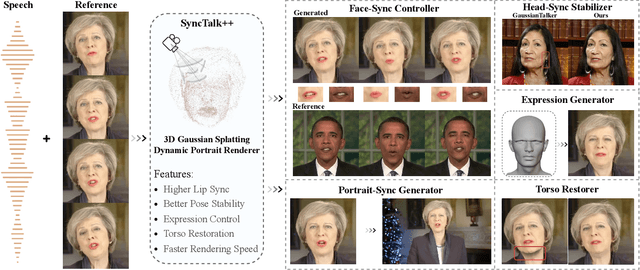
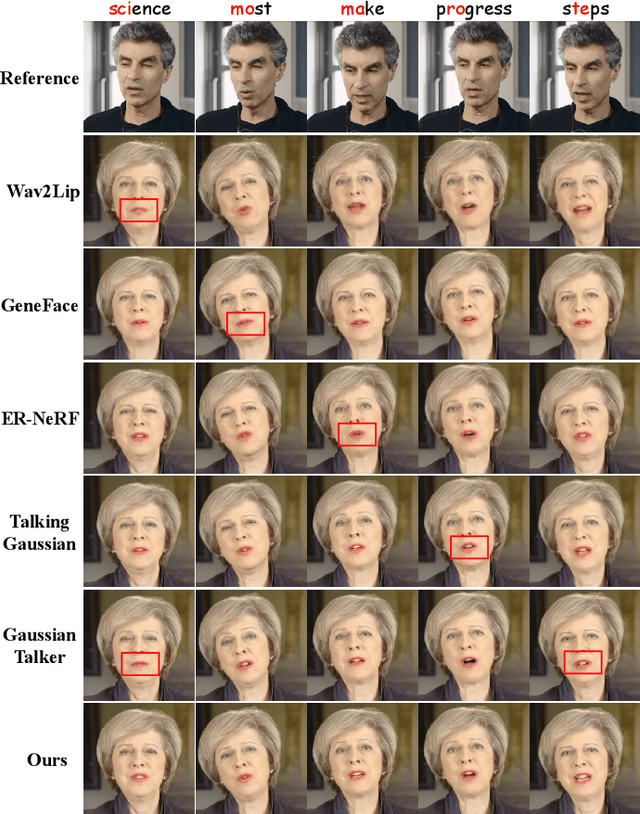
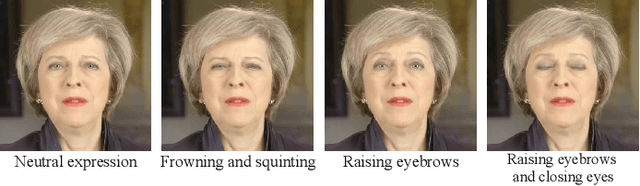
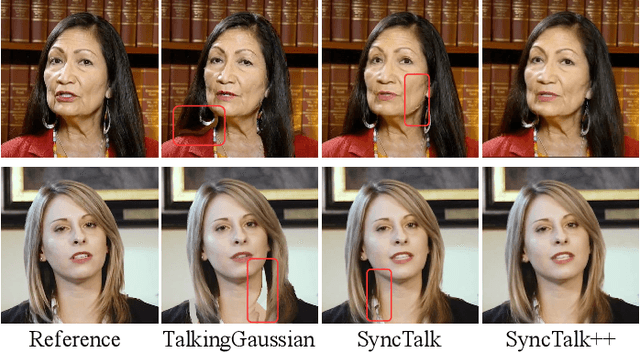
Achieving high synchronization in the synthesis of realistic, speech-driven talking head videos presents a significant challenge. A lifelike talking head requires synchronized coordination of subject identity, lip movements, facial expressions, and head poses. The absence of these synchronizations is a fundamental flaw, leading to unrealistic results. To address the critical issue of synchronization, identified as the ''devil'' in creating realistic talking heads, we introduce SyncTalk++, which features a Dynamic Portrait Renderer with Gaussian Splatting to ensure consistent subject identity preservation and a Face-Sync Controller that aligns lip movements with speech while innovatively using a 3D facial blendshape model to reconstruct accurate facial expressions. To ensure natural head movements, we propose a Head-Sync Stabilizer, which optimizes head poses for greater stability. Additionally, SyncTalk++ enhances robustness to out-of-distribution (OOD) audio by incorporating an Expression Generator and a Torso Restorer, which generate speech-matched facial expressions and seamless torso regions. Our approach maintains consistency and continuity in visual details across frames and significantly improves rendering speed and quality, achieving up to 101 frames per second. Extensive experiments and user studies demonstrate that SyncTalk++ outperforms state-of-the-art methods in synchronization and realism. We recommend watching the supplementary video: https://ziqiaopeng.github.io/synctalk++.
MLLM-Enhanced Face Forgery Detection: A Vision-Language Fusion Solution
May 04, 2025Reliable face forgery detection algorithms are crucial for countering the growing threat of deepfake-driven disinformation. Previous research has demonstrated the potential of Multimodal Large Language Models (MLLMs) in identifying manipulated faces. However, existing methods typically depend on either the Large Language Model (LLM) alone or an external detector to generate classification results, which often leads to sub-optimal integration of visual and textual modalities. In this paper, we propose VLF-FFD, a novel Vision-Language Fusion solution for MLLM-enhanced Face Forgery Detection. Our key contributions are twofold. First, we present EFF++, a frame-level, explainability-driven extension of the widely used FaceForensics++ (FF++) dataset. In EFF++, each manipulated video frame is paired with a textual annotation that describes both the forgery artifacts and the specific manipulation technique applied, enabling more effective and informative MLLM training. Second, we design a Vision-Language Fusion Network (VLF-Net) that promotes bidirectional interaction between visual and textual features, supported by a three-stage training pipeline to fully leverage its potential. VLF-FFD achieves state-of-the-art (SOTA) performance in both cross-dataset and intra-dataset evaluations, underscoring its exceptional effectiveness in face forgery detection.